Greywater Reuse: Costs and Benefits for Oahu Multifamily Housing
July 7, 2026


By Jordan Stewart, PE | Senior Discipline Civil Engineer | Honolulu
With water and sewer costs continuing to rise in Hawaii, developers and owners are placing greater emphasis on strategies that can reduce long-term operating expenses. Recent changes in billing structures on Oahu have shifted a greater portion of sewer charges toward volumetric usage rather than fixed fee, increasing the financial value of conservation and reuse.
This shift makes water reuse systems particularly relevant for multifamily residential projects. When more of the monthly utility bill is tied directly to consumption, reducing potable water demand and wastewater discharge can translate into meaningful cost savings. Advances in packaged treatment systems have also made greywater reuse more accessible and practical for project teams to evaluate.
For multifamily developments, this creates an opportunity to influence both project design and long-term operating performance. Incorporating greywater reuse early allows teams to evaluate not only potential cost savings, but also how system integration can support broader project goals such as sustainability, infrastructure efficiency, and long-term asset value.
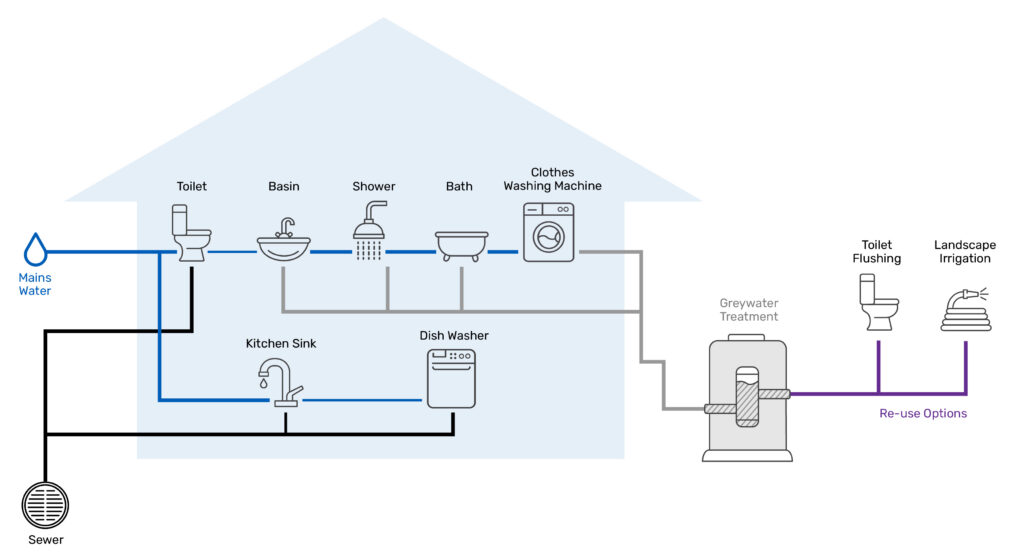
Greywater refers to wastewater generated from showers, bathtubs, bathroom lavatories, and clothes washing machines. These sources represent a significant portion of residential water use while avoiding the higher contamination risks associated with blackwater generated from toilets, kitchen sinks, and dishwashers.
In a typical multifamily development, these greywater sources can represent a substantial and consistent supply that can be reused for non-potable applications. Common reuse applications include irrigation and toilet flushing, allowing projects to offset a portion of potable water demand and reduce wastewater discharge.
An important principle to consider: greywater system performance is often governed by how effectively the water is reused, rather than the available supply. Applications such as toilet flushing and irrigation of large, landscaped areas provide consistent demand that supports reliable system operation.
Understanding where greywater comes from, and how it can be reused, is essential in determining whether a system can be effectively incorporated into a project. While greywater reuse has traditionally been associated with small-scale applications, larger multifamily developments offer opportunities to capture greater efficiencies and savings.
Greywater systems can provide significant advantages for multifamily developments, especially in locations where utility costs and infrastructure demands continue to increase. When thoughtfully integrated into a project, these systems can reduce operating expenses, improve asset value, and support more efficient use of existing infrastructure.
One of the most direct benefits is the reduction in water and sewer utility costs. By offsetting potable demand and reducing wastewater discharge, greywater systems can meaningfully lower monthly expenses. Over time, these savings can exceed initial installation costs, especially in larger developments where system efficiencies improve with scale.
Lower utility costs can also increase property value. Reduced monthly expenses improves affordability, which may support higher rental rates or sales prices. This creates an opportunity for developers to recover upfront investment while also providing a marketable sustainability feature.
Greywater systems can also support project-level efficiencies. Reduced demand for potable water and sewer infrastructure may limit or defer off-site upgrades and, in some cases, support higher-density development. This is particularly apparent when redeveloping an urban site with aging utility infrastructure servicing the site that is approaching capacity.
While these benefits are significant, greywater systems introduce additional considerations. Permitting requirements may extend timelines, and early coordination with agencies is critical.
Operation and maintenance are other key factors. Unlike conventional systems that transfer wastewater off-site, greywater systems require ongoing management. This includes monitoring system performance, maintaining treatment equipment, and conducting periodic testing to ensure regulatory compliance. Property owners and operations teams must be prepared to take on these responsibilities.
Evaluated early, these constraints can be incorporated efficiently without compromising overall project budget, schedule, and execution.
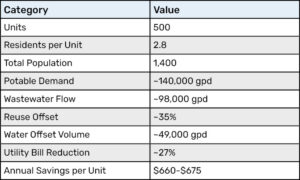
To illustrate how greywater reuse can impact a typical development, consider a 500-unit multifamily building in Honolulu with an average occupancy of 2.8 residents per unit. This results in a total population of approximately 1,400 residents.
Based on typical planning assumptions, this population would generate approximately 140,000 gallons of potable water demand per day and 98,000 gallons per day of wastewater. A greywater system designed to offset approximately 35% of total water demand would reduce potable water use by roughly 49,000 gallons per day.
This level of reuse can translate into meaningful financial savings. For a typical unit, combined water and sewer costs could be reduced by approximately 27%, resulting in annual savings of roughly $660 to $675 per unit. While actual savings will vary depending on project specifics and utility rates, the example demonstrates the potential scale of impact.
Key Metrics – Example Scenario
Greywater systems present a valuable opportunity for multifamily developments to reduce operating costs and improve sustainability. However, successful implementation depends on early planning and stakeholder support.
Projects that evaluate greywater reuse during initial design phases are better positioned to integrate system requirements such as plumbing layout, equipment space, and permitting. Early consideration also helps ensure alignment between owners, developers, design teams, and regulatory agencies.
While greywater reuse introduces additional considerations, the potential benefits make it a strategy worth evaluating for large-scale residential developments. With rising utility costs and growing emphasis on resource efficiency, greywater systems can play an important role in future project design.
Related services: Civil Engineering, Water & Wastewater Services
Coffman is a locally driven engineering firm reinforced by a national network of multidiscipline capabilities. Our teams and processes scale quickly and move nimbly, allowing us to provide engineering solutions that are smart, practical, efficient, and have a positive impact on cost, scope, and schedule.
Contact Us
We’re entrepreneurs at heart who want to see your business and community thrive.
We draw upon our large network of talent to strive for excellence at every step.
Learn More
The right tools.
The right environment.
The right people.
Apply Now
Take a moment to review some of our news items and learn more about Coffman and our clients.
Stay Connected


